

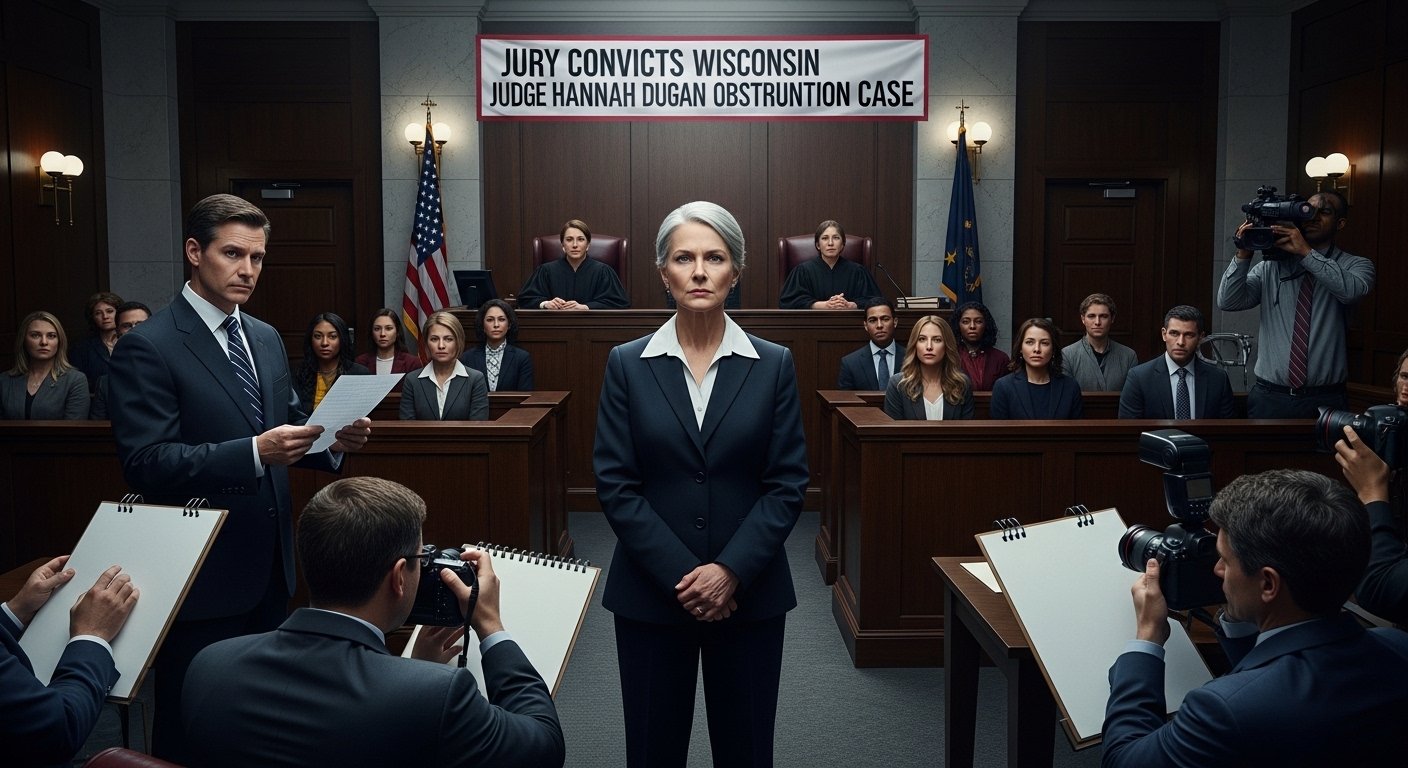
A federal jury in Milwaukee has convicted former Milwaukee County Circuit Judge Hannah Dugan of felony obstruction of a federal proceeding under 18 U.S.C. § 1505. The verdict, returned on December 18, 2025, followed a weeklong trial in the U.S. District Court for the Eastern District of Wisconsin. Jurors acquitted Dugan on a related misdemeanor count of concealing an individual from arrest under 18 U.S.C. § 1071.
The case centered on events that unfolded inside the Milwaukee County Courthouse on April 18, 2025. Federal immigration agents from U.S. Immigration and Customs Enforcement (ICE) arrived with an administrative warrant to arrest defendant Eduardo Flores-Ruiz, who was appearing before Dugan on a state domestic-violence charge. Prosecutors alleged Dugan knowingly impeded the agents’ efforts by confronting them in the hallway, redirecting them, and then directing Flores-Ruiz and his attorney to exit through a restricted side door and stairwell. Surveillance video and courtroom audio captured portions of the interaction.
Dugan, who had served as a state circuit judge for nine years, maintained that her actions were consistent with courthouse security practices and reflected confusion over evolving protocols for federal immigration enforcement inside state facilities. She denied any corrupt intent to obstruct justice. Following the conviction, Dugan resigned her judicial position in early January 2026.
The outcome marks the first federal conviction of a sitting state judge for obstructing an ICE administrative arrest inside a courthouse. It arrives amid heightened national focus on immigration enforcement and raises practical questions about the balance between state judicial operations and federal authority.
Background & Legal Context
Federal immigration enforcement operations inside state courthouses are not new, but they have become more visible in recent years. ICE and other Department of Homeland Security components routinely execute administrative warrants for removal proceedings. These warrants differ from judicial warrants issued by federal courts; they are issued by immigration officers and do not require the same probable-cause showing before a neutral magistrate.
Courthouses have long grappled with how to accommodate federal agents while protecting the due-process rights of all parties and maintaining public safety. Many jurisdictions maintain informal or written protocols for notification when federal agents appear. In Milwaukee County, internal judicial emails introduced at trial showed judges discussing draft policies on handling immigration activity in the building in the weeks leading up to April 18, 2025.
The charges against Dugan invoked two infrequently paired statutes. Title 18 U.S.C. § 1505 criminalizes corruptly influencing, obstructing, or impeding the “due and proper administration of the law under which any pending proceeding is being had before any department or agency of the United States.” The government’s theory treated the ICE administrative arrest as a “pending proceeding.” The companion misdemeanor, 18 U.S.C. § 1071, prohibits harboring or concealing a person for whom a federal warrant or process has been issued.
Both statutes require proof of knowledge and intent. Section 1505 additionally demands that the defendant acted “corruptly”, a term courts have interpreted to mean with an improper purpose. The jury’s split verdict; guilty on the felony but not guilty on the misdemeanor, suggests it accepted the government’s view that Dugan’s conduct impeded the proceeding but did not meet the separate elements of concealment.
Key Legal Issues Explained
At its core, the case turned on whether a state judge’s courtroom management decisions can constitute federal obstruction when federal agents are present to execute an administrative warrant. Prosecutors argued that once Dugan learned ICE agents were in the hallway seeking Flores-Ruiz, any affirmative step to move him out of their reach crossed into criminal territory. Defense counsel countered that judges routinely call cases out of order, grant brief continuances, and direct parties to use secure exits for safety or efficiency, actions that remain lawful even if they incidentally complicate an arrest.
The “corruptly” element under § 1505 proved pivotal. Federal courts have long required more than mere knowledge that an arrest might be delayed; the government must show the defendant acted with an improper purpose. Jurors heard never-before-released courtroom audio in which Dugan’s clerk announced “five ICE guys in the hall,” followed by Dugan’s instructions to the defense attorney. Prosecutors played the sequence to demonstrate intent; the defense highlighted context, including prior judicial discussions about courthouse security protocols.
Another contested issue was the nature of the “pending proceeding.” The government contended that an ICE administrative arrest warrant itself qualifies as an agency proceeding under § 1505. Defense motions argued the statute was never intended to criminalize routine courtroom administration and that applying it this way risks chilling legitimate judicial discretion. Post-trial briefing continues to test that legal boundary.
Latest Developments or Case Status
Following the December 18, 2025 verdict, Dugan filed post-trial motions for judgment of acquittal and a new trial. As of February 2026, federal prosecutors had responded in opposition, and the district court had not yet ruled. Sentencing remains unscheduled; Dugan faces a statutory maximum of five years’ imprisonment and a $250,000 fine on the felony count, though first-time nonviolent offenders in similar cases often receive probation or home confinement.
Dugan resigned her judicial seat in January 2026, citing the conviction’s impact on her ability to serve. Wisconsin state law generally removes elected officials upon felony conviction, but formal entry of judgment and sentencing had not yet occurred when she submitted her resignation letter to Governor Tony Evers.
The case drew national attention and public protests outside the federal courthouse. Interim U.S. Attorney Brad Schimel emphasized after the verdict that the prosecution was not politically motivated but reflected a straightforward application of federal law to protect law-enforcement operations.
Who Is Affected & Potential Impact
State court judges, court administrators, and local law-enforcement agencies across the country now face heightened scrutiny whenever federal immigration agents appear. The verdict underscores that courthouse personnel enjoy no special immunity from federal obstruction statutes. At the same time, it leaves open practical questions about how judges should handle simultaneous state proceedings and federal enforcement actions without inadvertently violating the law.
Immigration defendants and their counsel may experience increased caution in state court appearances when removal warrants are known to exist. Defense attorneys have reported more frequent requests for continuances or remote appearances in jurisdictions with active ICE presence. Courthouse security directors are reviewing or drafting clearer written protocols to reduce ambiguity for both state employees and federal agents.
The general public and immigrant communities are also affected. The case has intensified debate over the proper balance between federal immigration authority and the independence of state courts, which handle the overwhelming majority of criminal and family-law matters involving noncitizens.
What This Means Going Forward
The Dugan conviction establishes a precedent that state judicial actors can be held criminally accountable under § 1505 for conduct that impedes federal administrative proceedings inside a courthouse. Appellate courts will ultimately decide whether the jury instructions and the government’s interpretation of “pending proceeding” survive review. Defense counsel has signaled a strong appeal, focusing on the breadth of § 1505 and the interplay with routine judicial discretion.
In the interim, state judicial conferences and bar associations are expected to issue guidance on courthouse-federal enforcement interactions. Legislatures in some states may consider statutes clarifying the limits of federal authority inside state facilities. Federal prosecutors, particularly in districts with large immigrant populations, now have a tested template for similar investigations.
Practically, judges and court staff should document any interaction with federal agents and consult with court counsel before taking actions that could be construed as directing parties away from known enforcement operations. Clear, written courthouse policies; distributed in advance and consistently applied, offer the best protection against future disputes.
Frequently Asked Questions
What exactly was Judge Hannah Dugan convicted of?
She was convicted of one felony count under 18 U.S.C. § 1505 for corruptly obstructing or impeding a pending federal agency proceeding; specifically, ICE’s administrative arrest of Eduardo Flores-Ruiz. She was acquitted of the misdemeanor concealment charge under 18 U.S.C. § 1071.
Why was the case tried in federal court?
The charges alleged violations of federal criminal statutes involving a federal agency (ICE). Federal courts have exclusive jurisdiction over such offenses.
Does the conviction automatically remove a judge from the bench?
In Wisconsin, a felony conviction typically results in removal, but formal processes (including sentencing and any appeals) must conclude. Dugan resigned voluntarily shortly after the verdict.
What is the likely sentence?
Although the statutory maximum is five years, sentencing guidelines and the judge’s discretion typically result in probation or minimal incarceration for first-time, nonviolent offenders with significant community service records. No date has been set.
Can Dugan appeal?
Yes. Post-trial motions are pending, and a direct appeal to the U.S. Court of Appeals for the Seventh Circuit is expected once final judgment is entered. Common grounds include sufficiency of the evidence, jury instructions, and the scope of § 1505.
Does this case affect other judges?
It serves as a cautionary precedent. Judicial officers nationwide are reviewing local protocols to ensure compliance with federal law while preserving the ability to manage their courtrooms safely and efficiently.
Conclusion
The jury’s verdict in the Hannah Dugan obstruction case clarifies that state court judges are subject to federal criminal law when their actions are found to impede lawful federal agency proceedings inside the courthouse. The split verdict and ongoing post-trial litigation illustrate the factual and legal complexity of balancing judicial administration with immigration enforcement. As appeals proceed and courts issue further guidance, legal professionals, court administrators, and policymakers will continue to monitor developments closely.
You May Also Like: Ana Reyes Misconduct Complaint Dismissal: D.C. Circuit Upholds Judicial Independence
Disclaimer:
This article is for informational purposes only and does not constitute legal advice. Readers facing similar situations should consult qualified counsel and refer directly to official court records and applicable statutes.